The mist of uncertainty is starting to clear. The Government, in announcing a hard end date for the life-saving COVID supplement, signals that its top priority is reinforcing its pre-pandemic ideology on all of us.
To be sure, cynics saw this coming. Hammering on about the economic crisis from the very beginning, the Prime Minister’s concerns were never about the loss of life and crippled public health, but about the drastic reduction in the capacity of business to quickly bounce back.
But a rapid return to normal seems unlikely, Herculean forecasts of the RBA aside.
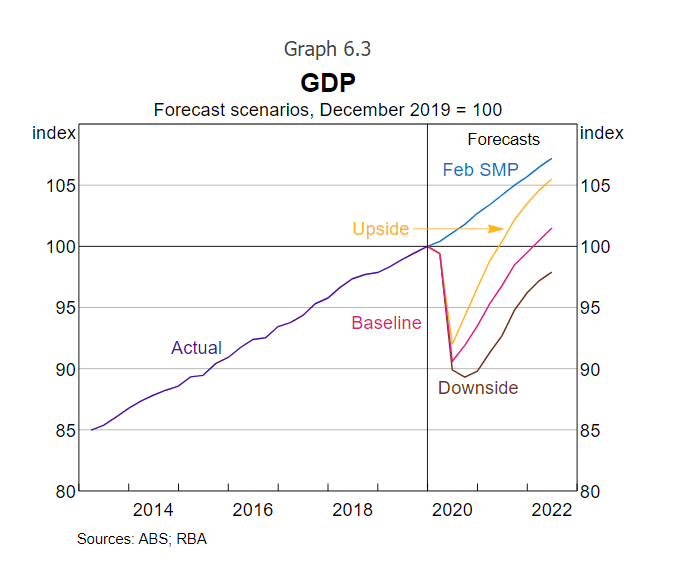
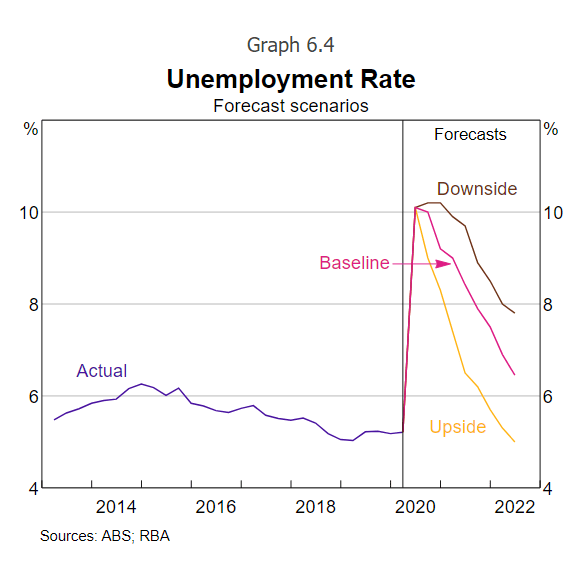
Australian retail, on the one hand, naturally dependent on consumption, is already at catastrophically low levels. In an uncertain environment where jobseekers can see a return to poverty-level subsistence just over the horizon, September 24th, and optimism for even jobkeepers remains low, “rational economic actor” behaviour would be to service debt and save. Not to consume.
It’s important to remember that the pre-pandemic economy was structurally unable to provide jobs to millions of people, and that the majority of people on welfare payment were forced into a macabre ritual of a futile job search. The fact that millions more Australians than before will be structurally unable to find employment in a shrinking economy certainly doesn’t bode well for discretionary spending.
Another factor to consider is the impending freeze of immigration-based population growth. It’s uncontroversial to state that the government directly relies on high immigration levels for growth. In a post-pandemic world, where international travel becomes much more restricted, where anti-Asian racism drastically reduces the desire for Chinese students to come to Australia, and where anti-immigrant sentiment becomes the official position of the Opposition, the compounding effects to the country’s prosperity cannot be understated.
Possibly on the bright side, the property ponzi will be impossible to maintain in this environment.
The question of sentiment also hangs heavy in the air. The government’s three-step plan to reopen the country (I hesitate to demean our humanity by repeating “economy”) has a key assumption that everyone is desparate to escape the confines of their personal prison, and lavishly spend to restore the gaping hole left by the idle months.
Indeed, the post-lockdown surge appears to be real. But widespread spending on luxuries like travel and restaraunting are predicated, in addition to economic confidence, on mass confidence that the health risks are minimal and well-contained. It remains to be seen whether or not that will hold true.
Finally, China. In the previous crisis of capitalism, China’s economic heft, alongside local mass stimulus, kept the Australian economy afloat for another twelve years of uninterrupted growth. And while direct stimulus is ideological anatheama to the current Government, it seems prudent to ensure healthy trade with post-pandemic countries with recovering consumption.
But even as Australia is both exploited as a geostrategic wedge against the world’s largest economy, and self-inflicts damage to its own relationship with its largest trading partner, it appears comletely ignorant of its own exposure to collateral damage. Indeed, that appeared to be the acrimonious reaction of the commentariat to suggestions by the Chinese Ambassador that Chinese consumers might exercise their autonomy and reduce consumption of Australian goods.
It appears the hawks haven’t fully considered the consequences of their own policy; a strategic blunder shared by their US counterparts. A reduction in international students, tourism, and exports with our largest trading partner will guarantee a sharp burst of economic pain, that must jeopardise an optimistic view of recovery.
The foundation for recovery is far from solid, and the Government appears to have locked itself in the infallibility of its economic mythmaking. If the government wishes to timebox its pandemic period as a special disaster plan, then it follows that the conditions of its economy will exist after the disaster is deemed over. A rocky path lies ahead, with no plans to smooth it over.
 A Means of Digital Reproduction