Crusaders – Western Warrior Governance

I, like most observers, were astonished by the reporting last week that 6 million workers were accessing the JobKeeper salary subsidy; including up to 800,000 people finding themselves in winding Centrelink queues, 56% of the labour force were receiving government support.

If you count those uncounted in the labour force numbers, the April unemployment rate jumps from a somewhat rosy 6.2% to an astonishing 10.2%, but the subsidised percentage drops to 53%. Small comforts for the government, I’m sure.

But the Government yesterday revealed that an “accounting error” caused by the paperwork blunders of just 1000 companies (of a approximate 728,000+ companies accessing JobKeeper) left the scheme with $60 billion unused funds, and 3 million less workers covered than expected.

How on earth does such a glaring miscalculation happen? And how was it not immediately recognised?

First things first. From the Prime Minister’s own press release of JobKeeper:

The Morrison Government will provide a historic wage subsidy to around 6 million workers who will receive a flat payment of $1,500 per fortnight through their employer, before tax.

The $130 billion JobKeeper payment will help keep Australians in jobs as tackle the significant economic impact from the coronavirus.

Immediately, the cover story falls over. The Government announced both the costing of the scheme, and the expected number of eligible workers weeks before businesses began to apply for the scheme. So, the wild disparity cannot be the responsibility of dodgy paperwork.

It’s shameful for the Treasurer to hide behind a public servant patsy in trying to explain away this disparity. But, there has to be a reason why the initial modelled expectations have diverged so far from reality.

Could it be that the Government’s explicit crusade against migrant workers, casuals, the arts and education sectors prevented 3 million fewer workers from accessing the scheme than predicted?

It is well known that the Government explicitly rewrote, three times, the JobKeeper criteria to exclude universities, now facing existential threat and cuts of staff and offered courses.

As seems to be the case with this Government, its policy is designed to reward those it deems worthy, and to mercilessly punish those that it views as ideologically despicable.

Investment fund managers, barristers, doctors and pensioners who reported a temporary dip in income are among the growing list of people being paid the federal government’s JobKeeper subsidy.

Fundies join barristers on JobKeeper, AFR

This week brought another fresh example of rabid Government ideology taking precedence over cooler heads – the absolute nadir of the Australia-China relationship. While the Australian press fawned over a propaganda victory for the small Pacific power, careful examination of the timeline and actors involved shows how fraught and poorly executed this Washington whisper was.

The propaganda angle of WHA73 cannot be understated: the key results being that that China supported the resolution for a global review of pandemic response, but the USA did not. Xi Jinping pledged $2 billion USD funding to the WHO and pledged the COVID vaccine as a global public good. The USA and UK, in sharp contrast, are fighting against contributing to a global pool of patents.

But you won’t hear a whisper of that in Western press.

Let’s be clear – Australia’s proposals for an explicit investigation of China’s pandemic handling, conducted by an empowered WHO “weapons-inspector”-esque team, was completely rejected. The only thing heard was a loud foghorn in Beijing, signalling that Australian policymakers are completely captured by Washington’s interests.

And this is just the latest example of a long list of actions that demonstrate this – the most salient being Turnbull’s Huawei 5G ban. Malcolm Turnbull himself admitted in his memoir that there was “no smoking gun” evidence to ban Huawei. At the very least, there are inklings of some deeper reflective, concillatory thinking appearing.

As if we needed more evidence that the intelligence agencies are deeply driven by red-yellow peril.

The fallout of acting the imperial vanguard is starting to appear, in the form of a crumbling trade relationship. Despite media assertions that trade restrictions on barley and beef are retaliatory, while certainly a potential motivation, there exists a bilaterial equality element to China’s trade policy that is consistently downplayed, poorly understood, and potentially justified.

A damaged economic relationship with China would be detrimental to the Australian economy. China purchases 30% of our exports, and is vital for the tourism and education sectors. We, on the other hand, do not have nearly so much leverage. It is frankly suicidal to sabotage this for an ideological crusade. But we are being dragged into a struggle that is not our own.

Each diplomatic blunder drags the country more and more into an alignment with the US-capitalist bloc, of those hawks that would eventually condemn us to war in order to protect white Western supremacy, and the profit of capital. This is clearly, in my view, not in any peace-loving people’s best interest. And it must be resisted in the strongest terms.

Given this climate, it certainly is an uphill battle.
Ideological Doona

The Prime Minister likes to frame the unwinding of pandemic health and economic measures as “coming out from under the doona, the infantilising implication being that we’re cowering from the ficticious boogeyman. Scott Morrison and the Government, the clear-eyed adults gently beckoning us to come out, into reaity and normalcy.

However, the Government are stuck under their own ideological doona, from which they steadfastly refuse to emerge from, the consequences of such disengagement left for those of us outside to compensate.

Primarily, the primacy of neoliberal economic ideology prevents the Government from any activity that may subvert the primacy of the market-based economy.

Clearly, they were forced to intervene once it became clear that the pandemic-induced demand contraction would wreak total havoc on the base structure of the economy.

The April Labour Force statistics, along with JobKeeper and JobSeeker data illustrate this starkly. Six million out of the 12.4 million employed in Australia are on the JobKeeper salary subsidy. That is, six million Australians have their salary of up to $750 a week paid for by the Government, in order to keep them officially employed.

This is possibly the most radical government intervention in the economy in Australian history, and is commensurate to the degree of this particular crisis of capitalism.

There are two fundamental questions.

Firstly: The minimum wage in Australia is $740 a week, the median wage (August 2019) $1100 a week. There are a significant portion of workers subsidised at a rate far less than their salaried remuneration – how will this affect post-lockdown sentiment and consumption?

Secondly: Given pre-existing economic pessimism, variability of lockdown easing across the nation, the timeboxed nature of enhanced government subsidies, and the uncertain possiblity of a snap-back recovery, how many of those precariously receiving JobKeeper will find themselves miserably queueing for JobSeeker?

That is, can this economy survive without crutches?

The pre-pandemic economy was rife with structural issues, many exacerbated by its own policies, that the Governemnt sought to downplay or ignore. Instead, it repeated and repeated its own view of reality, as if to throw its ideological doona over its mess.

In this unfolding catastrophe, who exactly needs to come out into the cold?

Those living precariously, barely affording rent, not knowing whether their job will exist when September ends? The millions finally receiving enough welfare to eat three meals a day, who have Poverty Day marked on their calendars?

Or those neoliberal warriors in the government and commentariat who demand human sacrifice to appease The Line?

The Uncertainty of Post-Pandemic Prosperity

The mist of uncertainty is starting to clear. The Government, in announcing a hard end date for the life-saving COVID supplement, signals that its top priority is reinforcing its pre-pandemic ideology on all of us.

To be sure, cynics saw this coming. Hammering on about the economic crisis from the very beginning, the Prime Minister’s concerns were never about the loss of life and crippled public health, but about the drastic reduction in the capacity of business to quickly bounce back.

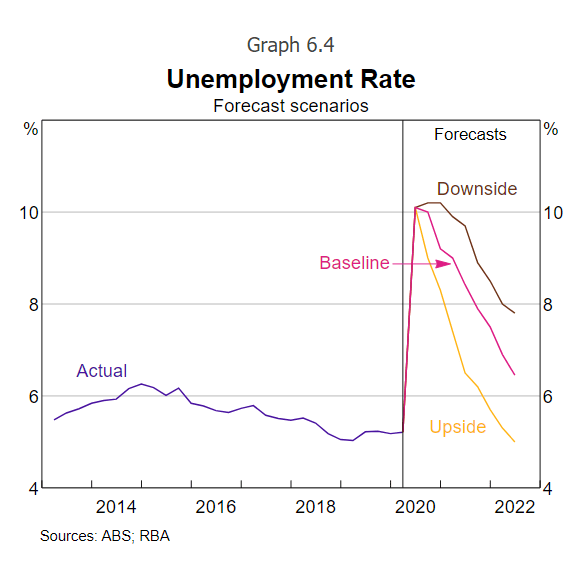
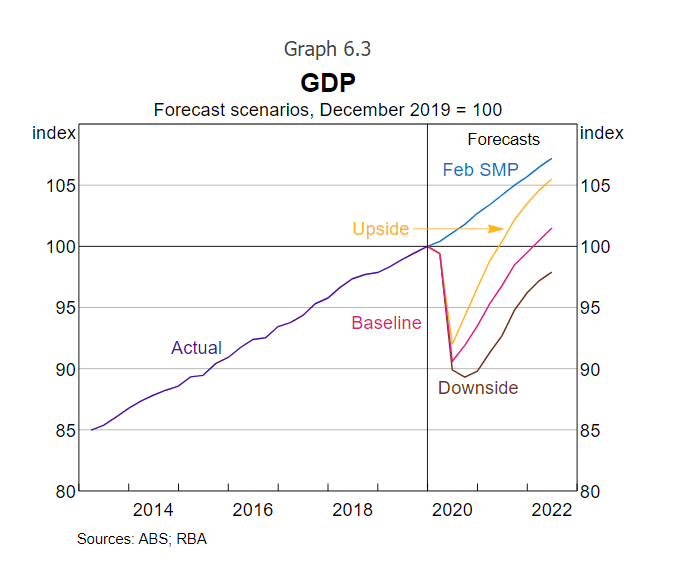
But a rapid return to normal seems unlikely, Herculean forecasts of the RBA aside.

Australian retail, on the one hand, naturally dependent on consumption, is already at catastrophically low levels. In an uncertain environment where jobseekers can see a return to poverty-level subsistence just over the horizon, September 24th, and optimism for even jobkeepers remains low, “rational economic actor” behaviour would be to service debt and save. Not to consume.

It’s important to remember that the pre-pandemic economy was structurally unable to provide jobs to millions of people, and that the majority of people on welfare payment were forced into a macabre ritual of a futile job search. The fact that millions more Australians than before will be structurally unable to find employment in a shrinking economy certainly doesn’t bode well for discretionary spending.

Another factor to consider is the impending freeze of immigration-based population growth. It’s uncontroversial to state that the government directly relies on high immigration levels for growth. In a post-pandemic world, where international travel becomes much more restricted, where anti-Asian racism drastically reduces the desire for Chinese students to come to Australia, and where anti-immigrant sentiment becomes the official position of the Opposition, the compounding effects to the country’s prosperity cannot be understated.

Possibly on the bright side, the property ponzi will be impossible to maintain in this environment.

The question of sentiment also hangs heavy in the air. The government’s three-step plan to reopen the country (I hesitate to demean our humanity by repeating “economy”) has a key assumption that everyone is desparate to escape the confines of their personal prison, and lavishly spend to restore the gaping hole left by the idle months.

Indeed, the post-lockdown surge appears to be real. But widespread spending on luxuries like travel and restaraunting are predicated, in addition to economic confidence, on mass confidence that the health risks are minimal and well-contained. It remains to be seen whether or not that will hold true.

Finally, China. In the previous crisis of capitalism, China’s economic heft, alongside local mass stimulus, kept the Australian economy afloat for another twelve years of uninterrupted growth. And while direct stimulus is ideological anatheama to the current Government, it seems prudent to ensure healthy trade with post-pandemic countries with recovering consumption.

But even as Australia is both exploited as a geostrategic wedge against the world’s largest economy, and self-inflicts damage to its own relationship with its largest trading partner, it appears comletely ignorant of its own exposure to collateral damage. Indeed, that appeared to be the acrimonious reaction of the commentariat to suggestions by the Chinese Ambassador that Chinese consumers might exercise their autonomy and reduce consumption of Australian goods.

It appears the hawks haven’t fully considered the consequences of their own policy; a strategic blunder shared by their US counterparts. A reduction in international students, tourism, and exports with our largest trading partner will guarantee a sharp burst of economic pain, that must jeopardise an optimistic view of recovery.

The foundation for recovery is far from solid, and the Government appears to have locked itself in the infallibility of its economic mythmaking. If the government wishes to timebox its pandemic period as a special disaster plan, then it follows that the conditions of its economy will exist after the disaster is deemed over. A rocky path lies ahead, with no plans to smooth it over.